Wednesday, July 15, 2009

Uncanny eXplorations: Dave Cockrum


So starting something slightly different from the norm. I've recently started to reread the Essential X-Men volumes that I have. For those unfamiliar, Marvel's Essentials lines are chronological reprintings of old Marvel comic books, printed on cheap news print in black and white to keep the cost down. They offer an incredible value really, especially for anyone who wants to read it "from the beginning."

The X-Men volumes, however, are somewhat confusing in their labeling. The Essential X-men collection actually starts at Giant-Sized X-Men, where the second generation of characters were introduced, including the first appearance of Storm, Nightcrawler and Colossus (as well as Thunderbird; he didn't fare so well comparatively.) Of course, the problem is that it skips nearly a decade of X-Men stories before that, including the earliest stuff by Lee and Kirby. So those have also been printed under the title Classic X-Men. The problem with that, being, there actually was a book already called Classic X-Men: a plus-sized book that was half reprints of old adventures, and half behind the scenes moments not original presented in the book. It is probably a better name than the confusing Essential Uncanny X-Men, seeing how the book Uncanny X-Men didn't get the adjective until after Giant Sized.

But I digress. I've decided, reading these old stories, to go through the history of Uncanny X-Men and look at each of the artists who have worked on the book, and specifically discuss the work they did in X-Men. This includes long runs (think Byrne or, in this very article, Cockrum) as well as guest-spots and annuals. Anything and everything that was published under the Uncanny banner.

So lets get started, shall we?


Dave Cockrum: Giant Sized X-Men 1, Uncanny 94-107; No Guest Spots, though Bob Brown finished his work on 106.


Dave Cockrum is the first artist to draw the X-Men after the relaunch of the title, designing the majority of the team that came on in Giant Sized X-Men. After working from a pair of scripts from Len Wein, Cockrum started a year-long run with Wein's assistant, some guy named Claremont, that lasted from issue 95 to 107. Claremont has said in various interviews that early on, he and Cockrum weren't sure what the book was going to be and so they felt a bit more freedom to experiment and see what worked. And it doesn't take much reading to see that they took that freedom to heart.

Giant Sized X-Men, despite introducing some of the most beloved and long-standing X-Men characters, is extremely odd for an x-book. The first half starts familiar enough: Professor X searches for new students for his school (though that plot point is very quickly forgotten) that shall double as new X-Men to help rescue the originals. Lead by Cyclops, naturally, the X-Men head into danger, unsure what they'll find. This where things take a decided left turn, as they battle the Living Island Krakoa, who has vines for veins and tree limbs for...well, limbs.

It is clear that it is these moments that Cockrum is really enjoying himself. There is a dynamic, frantic quality to it. When Cockrum's heroes scream, it is not a righteous battle cry, but a face contorted in horror. They are panicked, unsure and scared for their lives. Cockrum loves drawing monsters and aliens; the more exotic the locale the better. Cockrum always stated a fondness for Kirby's work, and it certainly shows. He relishes in the same excesses and strange perspective of reality that marked Kirby's career.

Even in the quiet, before-the-storm moments of Cockrum's work, there is a very palpable sense of dread and weight. Any time he does a close-up of anyone, it is a treat. Cockrum's human being is sweaty, pourous and quite often anxious. One of the core rules of horror is that terror can strike at any moment, and Cockrum makes it very clear that his heroes are very aware of this inescapable fact. They understand that the calm of their existence is only a brief vacation from the danger of their lives.

Of course, this danger doesn't just come across in the (oddly numerous) monster sequences: the Sentinels are treated as being just as horrific, and a battle with Magneto near the end of this early run is fairly unsettling, with loose debris flying through. During the great moments of horror, panel angels become more jutting and seemingly random. The chaos seeps beyond just the expression of the characters, but into the very page layout itself. Nothing is safe; in the final panel of 97, a double tiered window shot brings this point home very strongly: the X-Men are being observed and tortured, for our amusement. Are you amused?

This all somewhat undercuts the fact that Cockrum is a pretty daring superhero artist, especially for the era these books are being published (1975!). It is easy to see why with Cockrum's dynamic, film-like eye that the book quickly became Marvel's leader, along with Claremont's verbose but addictive writing style. (This isn't a series about Uncanny's writing, mainly because Claremont takes up so much of it, but it interesting to note that Claremont is also much more experimental in his writing style in these early issues. One of his most interesting devices is to have one moment where the unseen narrator actually eggs Scott Summers on to release his frustration.)

When early post-relaunch X-Men books are considered, the Byrne work is often considered the pinnacle, mostly because he did the bulk of the Phoenix cycle. But the tone is set by Cockrum, who immediately establishes that X-Men is a book unlike our superhero tales, where the bets are off and danger is very palpable. Part of the reason his X-Men are so human is that overriding sense of fear, and it sets the stage for the work that Byrne and all following artists do.

Sunday, July 5, 2009

Michael Mann's Public Enemies: The Art of Myth Making

WARNING: The review/essay covers the end of Michael Mann's film Public Enemies, only because it relates so strongly to the film's central themes. If you haven't seen it and don't want to be spoiled, I suggest you stop here, go see the movie and then come back. I will say, spoiler-free, that is excellent and probably Mann's finest film.

The opening scene of Public Enemies sets up rather masterfully the core of the movie itself: the setting is a prison-break at Michigan City, Indiana. The costumes are perfectly recognizable dirty black and white uniforms, trench coats and tommy guns. The energy escalates quickly and boils over. It is a perfectly pitched gangster movie, in the most classic tradition, only now it is shot in crisp, beautiful digital clarity.

For the next two and a half hours, however, Mann will begin to question and pick apart what we just watched. The film is obstensibly about the feud between bank robber John Dillinger and federal lawman Melvin Purvis (played expertly by Johnny Depp and Christian Bale, respectively; Bale especially transcends his usual stone-faced emotionlessness in portions and offers a career-defining performance), as well as how the actions of Dillinger and his fellow cross-country bank robbers led to the rise of the FBI to the institution it is today. But just underneath the surface of the plot, what Mann seems to be playing with is the notion of reality and how our perception is so often distorted by myth.

On one side, there is Dillinger's attempt to control his image in the media by always making sure he steals from banks, not individuals, and paints himself as the full realization of the American dream. Of course, he knows that his persona is merely a creation. At one point he calls banks "the place where all these people put their money"; later, with a gaggle of infatuated newsmen wrapped around his finger, he criticizes his younger self for stealing from a store-owner, again emphasizing that he doesn't steal from people, just institutions. He is a master manipulator, charming and quite often the smartest guy in the room. He looks out for his friends, but also knows that what he does is a business. The only relationship he has that doesn't feel contrived and a matter of control is his love affair with coatgirl Billie Frechette, to whom he promises the world. You almost suspect that Dillinger, for all the charm he has, wants to actually share something with someone, and decides that the person he wants to share with is Billie.

Equally obsessive is the FBI's J. Edgar Hoover, played with breathless exitement by Billy Crudup who only appears in two scenes of the film but hangs over the whole story. Crudup is the one who coins the titular phrase of the film, naming Dillinger "Public Enemy Number One." The Chicago branch of the FBI is turned into the nerve-center of the who operation due to its closeness to organized crime, and eventually it is renamed to "the Dillinger Department." Hoover's "war on crime" (which of course reverse-echos the war on drugs or war on terror, the way that America has developed a habit of declaring war on broad concepts; another myth) turns his g-man from mostly inexperience police officers into broodish thugs, at one point beating Frechette to the point where she can't stand. It is a clear and cutting criticism on the mindset that violence leads to conclusive results.

But in the end, it is neither Hoover or Dillinger who is the master myth maker. The true myth maker is Mann himself, or more broadly, Hollywood. Two of the most vital scenes in Public Enemies take place in movie theatres. The first is near halfway through the film, after Dillinger has been named Public Enemy #1 but before his gang has really started to feel the sting of the law. He sits in a movie theater, with his gang, watching a newsreel. (The newsreel itself is introduced masterfully: a scene where Hoover is posing with some "junior G-men" has Crudup mugging directly into the camera, talking to the audience. Talking to you. As you watch, the scene fades to gray and the sound softens. After several seconds, the camera begins to pull back, revealing a theatre full of viewers, of which you were just one.) As the Newsreel continues, a moment comes up where Dillinger, a real photo, is posted on the screen. The audience is instructed to look to the left, then the right, warned that their enemy could be anywhere. The audience of course does exactly as their told, but no one notices the actual PE#1 among them. As the scene ends, we see Dillinger slowly grin. It is impossible to tell if it a smirk of pride at not being caught, or admiration of Hoover so masterfully using the craft of film.

The other scene in a theatre is the climax of the film. Dillinger, betrayed and doomed to be killed before the traditional "big score" where he is supposed to die, goes to the movies once more. He goes to see Manhattan Melodrama. (It is a strange and unnerving fact of history that this works so perfectly for the narrative Mann tries to tell.) As Dillinger is among the crowd, all fixated on the screen, we spend our time split between watching the movie with him, just over his shoulder, the frame of the theatres screen just slightly tilted in the actual theatre screen, and watching Dillinger's face as he watches the movie. We keep cutting back and forth between Cary Grant and William Powell playing the roles of gangster heavies, wearing the trendy wispy moustaches of the day, only to cut Depp's Dillinger, same wispy moustache, same cool demeanor. The transformation is now complete. Depp is Dillinger is Cary Grant. They are all legends, all something that belongs to the world and more than their simple lives could hold. We are the voyeurs, the observers. Those patrons of film earlier in the film, being told to look to the left and the right, are still being pulled along.

Moments later, Dillinger is killed by three bullets. It is at this point destined, unavoidable. But it is still shocking when it happens. The final bullet actually tears through Dillinger's face, fromt he back through to just underneath his eye. Again, the digital crispness of the moment is captured, an extreme close up of Dillinger's face as he realizes beyond any hope that he is dead. The death recalls the ends of Bonnie and Clyde or Butch Cassidy and the Sundance Kid, only Dillinger is alone; the high-arcing shot of the camera being elevated abovet he growing crowd around Dillinger's corpse is almost directly ripped from Chinatown, only now, the good guys have won. This is a moment you've seen before, only the punch is stronger for some reason. Depp and Mann have charmed us into caring about Dillinger, far more than you even realize until you see his eyes gloss over. The myth is over, completed in the only way it could be completed from the very start. And it couldn't sting any more.

Friday, February 6, 2009

Brand New: rock and roll psalmists


Jesse Lacey of Brand New


Recently when picking up a friend, I was listening to Brand New's incredible 2006 album The Devil and God Are Raging Inside Me. The second track on the album, "Millstone", includes one of my favorite lines on the entire album:

"I used to sleep without a single stir/Because I was about my Father's work."

My friend riding with me looked surprised and asked, "When did Brand New become a Christian band?" The term was certainly used in an insulting tone, to show that bands that openly addressed religion, God or Jesus was considered seperate from respectable secular music. And this was a Christian speaking.

But lead singer and lyricist Jesse Lacey has always been pretty open about the perspective he's coming from. His religion, or at least religious history, is vital for his lyrical voice. He shows a Biblical literacy that dwarfs several of his indie rock compatriots. The very title of "Millstone" is a reference to the 17th chapter of Luke; the song itself is a confession of sorts, Lacey openly pondering how he got to the sinful place he sees himself at:

"I used to pray like God was listening/I used to make my parents proud/I was the glue that kept my friend together/Now they don't talk and we don't go out/I used to know the name of every person I kissed/Now I made this bed and I can't fall asleep in it."

The clear indication here is that Lacey believes that he's fallen too far. In the chorus, he speaks of the classic "Ship of Fools" sinking, with him aboard and the allegorical millstone around his neck. He cries out for someone to save him so that he can live, but feels drawn down by his own sin. Its a song that is crying out for redemption. The fact that it is followed on the album called simply "Jesus" is no accident.

Of course, on an album with a title like
The Devil and God Are Raging Inside Me, religious subtext (or blatant references) are to be expected. But Lacey has been making Biblical allusions his entire career. Brand New's first album, Your Favorite Weapon, features a song called "Seventy Times 7". The song is about an experience where Lacey, betrayed by one of his friends, cannot find it in himself to forgive him. While the song certainly doesn't extol any Christian values (not that any Brand New songs do; they are certainly not evangelical), the title and the one line:

"They say you need to pray if you want to go to Heaven/But never told you what to do if your whole life's gone to Hell"

let the listener in on the joke: Lacey is releasing what he views is righteous anger against his brother (what he calls in the song his "best friend") without sinning. The end of the song even has Lacey relishing thoughts of his best friend's death:

"So have a few more drinks and drive your home/Hope there's ice out on the road/And you can think of me when you forget your seatbelt/And again when your head goes through the windshield."


Lacey's religious moments are tense at best. He is caught between a desire for redemption but an awareness of his own shortcomings. In the song "Degausser," he questions the dimensions of grace, wondering if with all of his sins if he can really be forgiven. It is equal parts yearning and fearful. In the final climatic moments, after all of the screaming and anguish, a single tinny voice rises, as the music starts to fade:

"Take me, take me back to your bed/I love you so much that it hurts my head/I don't mind you under my skin/I let the bad parts in, the bad parts in/Well you're my favorite bird and when you sing/I really do wish that you'd wear my ring/No matter what they say, I am still the King/The storm is coming, the storm is coming in"

At first blush the line is easy to read about a girl, especially seeing how it is Lacey who's singing still. But if your perspective is slightly skewed, and you imagine a second voice coming in:

"Take me, take me back to your bed/I love you so much that it hurts my head/I don't mind you under my skin/I let the bad parts in, the bad parts in/Well you're my favorite bird and when you sing/I really do wish that you'd wear my ring/No matter what they say, I am still the King/The storm is coming, the storm is coming in"

Remember that bed and sleeping has already been used as a metaphor for the anxiety and guilt that Lacey feels for his transgresions. In this interpretation, the finale of the song is not a plea for a woman, but rather an assurance of pardon (the ultimate desire of the first four tracks of the album) and a loving word. While this interpretation may be wishful thinking, I also find it very powerful and fitting with the rest of the album. It is a final word of hope, which everything before it is searching for.

Wednesday, December 24, 2008

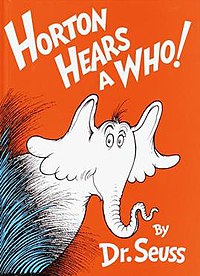
Horton Hear a Who (Seuss and the Dangers of Prophecy)


After the disaster that was the film adaptations of both How the Grinch Stole Christmas and Cat in the Hat, I decided to skip the recently made Horton Hears a Who animated film when it came to theaters. I just wasn't sure if I could see another example of my cherished childhood stories being translated into something "hip" and modern.

Thankfully, my local Blockbuster forced me to rethink my decision. Playing across one of the screens, used to sell Blu-Ray technology, I caught the very beginning of the film. And instantly, I was reminded of just how powerful of a story the Horton fable is, as is most of Seuss' work. What I hadn't realized as a child and didn't fully recognize until watching the animated variant as an adult is that at the core of the story is a call for brave prophecy and counter-culture action.

Much criticism and analysis has been offered to the Horton story as a post-WW2 allegory for the relationship between the United States and occupied Japan, presenting the United States as the protectors of a once proud, now humbled people. But more has to be read into this from an author of Seuss' background.

Seuss did a series of fairly incendiary political cartoons that depicted Japanese soldiers in the stereotypical racist style of the time. These cartoons have become something of an infamous portion of Seuss' career, showing the darker (and more human) of an otherwise beloved figure. It is not hard to see how Seuss' could have taken the situation seriously and personally; as a German-American who found the harsh actions of Hitler's fascism as an affront to humanity, he needed someone to post his anger and hatred on. Unable to demonize the Germans, like many other Germanic Americans, Seuss turned to the Japanese. Seuss once explained his relentless attack on the Japanese this way:

But right now, when the Japs are planting their hatchets in our skulls, it seems like a hell of a time for us to smile and warble: "Brothers!" It is a rather flabby battle cry. If we want to win, we’ve got to kill Japs?, whether it depresses John Haynes Holmes or not. We can get palsy-walsy afterward with those that are left.

So how is it that this man, who saw no difference between the Imperialist Japanese and Japanese-American immigrants, can get to the point to actually dedicate one of his books, one of his most beloved books, to a Japanese friend? Especially a story with the conviction that "A person's a person, no matter how small." That is a fairly unitarian message from someone who before adopted a rather "us versus them approach."

And even within the story, Seuss acknowledges that as simple as an idiom as this might seem, it has a dangerous ring to it. Horton's love and care of the Who's is not met with great acclaim. Rather, it is seen as an affront to the status quo, to the very stable nature of the jungle. The other members of the jungle are so shocked by the fact he can hear people on the tiniest speck (thanks to his relatively large ears, Horton can hear what others can't; this does the job standing in for the Bible's preferred symbol of vision), that they actually tie him up in ropes and throw him in a cage.

Being a prophet is dangerous. It is not just dangerous for the prophet, but for the society receiving the prophecy too. But as we see in the parallel story of the Who's reluctant to listen to their wise men (in the book and original Chuck Jones cartoon, Professor Whovee; in the more recent CGI cartoon, the Mayor of Whoville), that their reluctance to listen can make things far more dangerous. It is only by finally listening and raising their voices, every last one of them, are they saved at the last moment. Indeed, the danger (and sad commonness) of people not listening to their prophets is shown on both sides of the story. In one example, Whoville is almost destroyed by their sloth and inaction; in the other, Whoville is almost boiled to oblivion by fear and ignorance.

That latter example is probably the one that hit closest to home for Seuss.

Sunday, December 14, 2008

The Day the Earth Stood Still


In 1951, the original version of The Day the Earth Stood Still served as a sort of message of the cultural climate of anxiety of the time. In the still fresh radioactive afterglow of a WW2 victory, America was both excited and worried about its new found place at the forefront of an increasingly smaller Earth. The film, considered even now a classic of the golden era of 50s science fiction filmmaking, reflected on the fears of atomic power, authoritarian rule and what seemed (and still seems) like a technological advancement gone out of control.

The film also had a sense of religious and spiritual importance to it, specifically around the figure of Klaatu, wise alien visitor who's visage looked remarkably human. Played with cool authority by Michael Rennie, Klaatu's Christ-status is firmly set in the final moments of the film, where he is resurrected, delivers a final if somewhat ambiguous charge to those that have gathered around his spaceship and then accends into the sky with Gort, his robot guardian. Screenwriter Edmund North admitted to the Christ-parellels in the Klaatu character, although he always depicted them as being subtle. In reality, they are a single part of a much larger statement.

In the contemporary remake, starring the much less charismatic but far more alien Keanu Reeves in Klaatu role, similar Biblical allusions abound. The central point of the film is, like its predeccesor, a group of extraterrestial authorities have been made nervous by the actions of humans on earth. However, unlike the first film, the concern is not for the other alien planets near Earth (atomic power in the hands of such a relatively underdeveloped race makes them anxious, even more so than our own anxieties,) but for the Earth itself. The sins of global warming and poor ecological planning and stewardship are used to prove that the people of the planet Earth are unworthy to live, threatening the precious gift they have been given. "If humans survive, Earth dies. If humans die, Earth survives," Klaatu explains coldly to a reasonably concerned Jennifer Connelly, standing in as the prime defense for the fate of humanity.

The religious implications and allusions are fairly apparent in the set-up, reminding most prominently of the twin Genesis stories of Noah's flood and Sodom and Gomorrah. (In a moment of cringe-worthy exposition, the Noah comparison is bluntly explained to the viewer.) An authority (or in this case, collection of authorities) from above decide that the inferior humans are so wicked in their desires that they no longer deserve to live. They must be cleansed away for the planet and all of its other life to thrive. This judgement may seem harsh and cold, but really, it is also an act of love. As Klaatu himself explains, he doesn't come to save or destroy humanity, but rather to save the Earth. As Agent Smith from the Matrix would say, humanity is a cancer that must be exercised from the body of the planet, or it will become choked and wither.

The turn comes in the realization by Klaatu and other members of his unnamed races finally realizing that humans, for all their dangerous, destructive personality flaws, are also capable of great things, as well as capable of change. The final proof for Klaatu is the love Connelly's character has for her dead husband's son. They have no genetic bond, yet she loves him like her own. Through her love, his pain and the bond they create, Klaatu is convinced that these are a people capable of great things. In the final moments of the film, he speaks the most magic of all magic words in sci-fi, "Klaatu barada nikto", releasing humanity in the last moment from ultimate judgment.

The end is left ambiguous, much like its inspiration, leaving the fate of the earth in the hands of the audience. We are given the choice: to succumb to the great dangers of our destructive spirit, or appeal to the power of our ability for change, reform and most importantly love, for our families and our planet. And while there is no rainbow provided by Klaatu as he leaves Earth, he does explain that the direction of where we go now is our decision, with free will and commission to do great or terrible things. It is a heavy and daunting order.

Wednesday, October 22, 2008

W.


While this entry isn't firmly in the stated purpose of the blog, I have been thinking about this film since I saw it and so feel compelled to write my impressions.

It goes without saying that the current President isn't terribly popular. When respected newsmen like Paul Begala can say pretty inflammatory things about him without anyone arguing back, it is clear that our confidence in our country's leadership is at an all-time low. It is one of the main reasons I'd say that the country's eyeballs have been glued to the Presidential race like never before: after what the majority of America views as an eight-year costly mistake, we are ready to look forward and see where we can stumble towards now.

Except, one man is still looking backwards. Oliver Stone has made a biopic about a standing president, an unprecedented gesture from one of America's most enigmatic filmmakers. Stone's films are liberal, psychedelic and in many ways prophetic. He isn't afraid to criticize the country he loves, in the hope that through his criticism he challenges us to be better ourselves.

Thus it comes as a shock that W. is a largely sympathetic view of the man. Yes, Bush is presented as being conservative, short-sighted and a man of limited intellect (though Stone goes to great effort to push the idea that Bush's memory and personal skills are actually exceptional if nor admirable). But he is also presented through Josh Brolin's depiction as a complicated and tragic figure, a man who loves his country, his wife and, yes, his God.

I would argue that Bush is not the villain of the film, but he certainly isn't the protagonist either. Throughout the film, Bush feels the need to remind people that he is the President of the United States, or as he defines that role, the Decider. He makes the final choice in all cases. That is his power. He pushes the button, controls the pen.

Only, of course, he has no control over his destiny. He surrounds himself with dangerous men (most chillingly Richard Dreyfuss' Oscar-worthy turn as Dick Cheney) who have much less pure motives, but know which buttons to push to get W. on their side. Stone argues that Bush bought into his own smoke operation, that his movements against Iraq were based on his personal hate of Saddam Hussein and his desire to protect his country, not on the greed for oil that Cheney in the film openly states in the reason for this war.

The lasting image of the film, for me, is Bush as a man of great passion and personable character with limited vision. Throughout the film, we are reminded what a serious sports fan Bush is. He knows baseball the way that we expect presidents to know foreign relations. He is shown watching college football constantly in the height of his political difficulties. This obsession seems to shed some light on the limit of his political vision; Bush has generated much criticism for his "you're either with us or against us" stance, but the dichotomy perfectly reflects the mind-set of someone who views the world as a sports contest. Near the end of the film, Bush states his frustration and belief that there is Good and Evil in the world, and it is Good's responsibility to fight Evil.

There is no room for discussion or any gray area in that world view. And for Stone, that seems to be where Bush has fallen short and hurt our nation; we don't live in simple, black and white times. And we never have.

Tuesday, October 14, 2008

The Films of Brad Bird


Paul O'Brien, one of my favorite cultural bloggers, in his review of Ratatouille commented that the Brad Bird's two Pixar films are essentially a celebration of "well-founded elitism." The argument goes something like this: both The Incredibles and Ratatouille are about what can be described as supernaturally gifted people/animals that should not be ashamed of their gifts that they've been given and "true excellence should be celebrated."

All of that is certainly an interesting view of things, but I also can't help but think it is also a bit short-sighted. Yes, both Remy the Rat and the Parr family are displayed as being exceptional. But they also aren't shown as being perfect, or necessarily better than anyone else. The Parrs especially are shown as being jealous, self-obsessed and otherwise human throughout the film. Yes, they are heroes, and yes, in the end they do the right thing. But to say that they are elite or in some way elevated from common people seems to miss the point somewhat.

The Incredibles' core is about not merely taking charge of those exceptional qualities, but using those gifts towards bettering the world. To use the classic Stan Lee axiom, the Parrs learn that with great power, great responsibility isn't far behind. When Mr. Incredible sees victimization, he can't help but think that he should do something. There is a core somewhere in him, beneath that narcissistic streak (his own elitist tendencies) is a person called to selfless service of the world. Within the model of the superhero, Mr. Incredible serves as an example of doing the right thing with the ability you've been given.


While Ratatouille is certainly less flashy than Incredibles, it is no less prophetic in its charge to better the world in any way that you can. Remy the Rat is a gifted chef, due to his amazing sense of smell and taste. He is also an outcast; his rattiness causes him to be a reject due to his refined tastes not exactly being appreciated within his clan. So like many artists, he has to find his own place in the world, and figure out a way to express himself somehow, a wanderer without a home.

He finds his soul mate in Alfredo Linguini, the nervous but well-intentioned garbage boy who also has no family any more. Alfredo, who has no skill in cooking (like most of us, I'd assume) , needs a job, and has his last chance in the kitchen of the late Gusteau. Soon, a symbiotic relationship is created: Remy gets a home and gets to do his favorite thing and cook, Alfredo keeps his job and starts to get some fame. Remy and Alfredo help each other, and in the kitchen Remy quite literally moves Alfredo, reflecting the way some believe that people are "moved" by the spirit. Remy serves as a guide to Alfredo's hand, helping him to make excellent food for people.

But haute cuisine is really an elitist skill, isn't it? There is certainly a celebration of foodyism throughout the film, as well as a not so subtle condemnation of mass-produced frozen food. But what is more life-affirming, to say nothing of life-giving than food? It is one of the staples of human existence and community; there are several scenes throughout the film, including one prodigal sonesque party among the rats upon Remy's return that show the gathering of people around food; it is what initially binds Remy and Alfredo together.

As if to make the point, the film ends with the heartless Anton Ego being fed "peasant food," the titular dish. Instead of taking notes and critiquing the meal, he has a flashback to his childhood and how his soul would be lifted when his mother fed him. Food binds us, makes us human and keeps us alive. Remy's skill is feeding people, which is one of the things that Christ calls people to do: feed the hungry. Ratatouille may never feed the physically hungry, but he sees a hunger and emptiness in Anton Ego that needs to be fed as well.